
RESOURCES

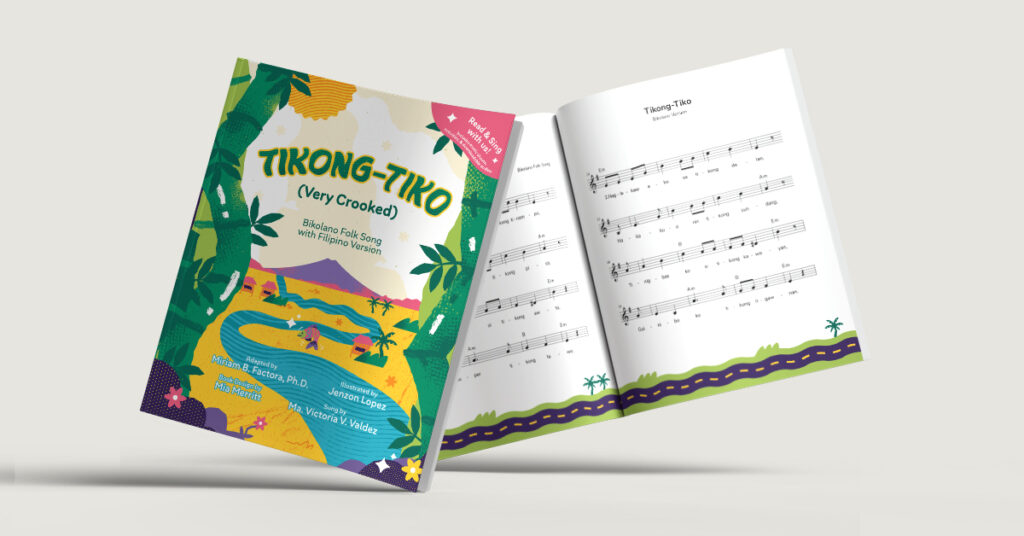
Tikong-Tiko | Very Crooked

FROM THE READ AND SING SERIES

The following are supplementary music activities that build upon those presented in the book published in December 2025. To maximize the learning experience, it is presumed that you already have a copy of the book. These activities are intended for facilitators and learners with more developed musical experience. Facilitators are encouraged to select activities that best align with their strengths and their learners’ needs. Ultimately, these resources aim to make music learning joyful, adaptable, and accessible to everyone.

Sample Concepts that may be learned from the song:

  • Beat
  • Rhythm 
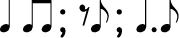
  • Rhythms that may be learned from the song:   
  • 2/4-time signature
  • Melodic concept: Harmonic minor scale
  • Tonic (i), Sub-dominant (iv), Dominant chords (V)

Sample Concepts, Skills to Be Developed, and Suggested Activities:

  • IN-TUNE SINGING
    • Students sing the song with words relatively in tune.
    • Chain Singing: Students take turns singing. At the teacher’s signal, each new singer picks up and continues where the last left off until the song ends.
    • Sing alone, with partners, or with a group.
    • Sing with or without accompaniment
  • A. PART- WORK This skill is the ability to perform more than one musical task at once.
    • Sing with the words and conduct in 2/4 time signature.
    • Sing the words while conducting and walking the beat, bending one knee on the strong beats.
  • B. HARMONY WORK
    • As students sing the song, they identify which of the primary chords—tonic (i), subdominant (iv), or dominant (V)—are used in the piece.
    • Assign a group to sing words, and the rest of the students sing the base of the chords— ‘la’ for tonic, ‘re’ for sub-dominant, and ‘mi’ for dominant.
  • NOTE READING 
    • Refer to the notation, clap the rhythm and say the rhythm syllables.
    • Suggested rhythm syllables for the specific rhythms: These are simply suggestions. You may create your own rhythm syllables to suit students’ needs or ideas.  (FIGURE 1)

Rhythm Rhythm Syllable Rhythm Rhythm Syllable

ta

(rest) ti

ti-ti

tam ti

    • Identify the key signature. The song has one sharp (F#) and it ends on E= ‘la,’ so it is in ‘e minor scale.’ 

      • SCALE is the underlying sequence of notes arranged from lowest to highest that forms the character and framework for the melody.

    • Read and sing in solfège with hand signs.

      • The Curwen Hand Signs were first developed by John Spencer Curwen (1816–1880) in England and later adapted by Zoltán Kodály (1882–1967) in Hungary. These gestures accompany the solfège syllables—do, re, mi, and so on—and provide visual and kinesthetic support that helps learners internalize pitch as it moves up and down in music.

    • Read and sing in letter names. F# shall be read as ‘Fis’ and D# shall be read as “Dis.” Each sharped note is sung with a single, clear, and simple syllable for ease of performance.

    • Sing in various key signatures. Use the table below to guide the pronunciation of sharped and flatted letter names. (FIGURE 3)

Flat Letter Sharp Flat Letter Sharp
As
A
Ais
Es
E
Eis
Bes
B
Bis
Fes
F
Fis
Ces
C
Cis
Ges
G
Gis
Des
D
Dis
  • NOTE WRITING / EAR TRAINING
    • The teacher writes several 4-beat rhythmic patterns using rhythms students have already learned, performs one of them, and asks students to identify which pattern was performed. Students may show their answer by writing only the letter label or by notating the entire rhythmic pattern.

Examples:

      1.      
      2.      
      3.      
      4.      
      5.      
      6.      

Extension: Use one of the patterns as ostinato for the song.

      • A RHYTHMIC OSTINATO is a short rhythmic pattern that is repeated over and over in the same way throughout a song or section of music. 
      • For example: Performing    “ti-ti ta ti-ti ta” over and over while a song is sung would be a rhythmic ostinato.
    • Students write rhythmic patterns dictated by the teacher without any choices provided.
    • The same ear training activities may be used to practice melodic concepts by writing solfège syllables below the rhythms.
  • IMPROVISATION: This is the ability to create rhythms, melodies, texts, and movements within set parameters, which forms the basis for composing music.
    • Improvise a 4-8 beat rhythmic ostinato using the rhythms learned in class and use it to accompany the singing.
    • Improvise specific body percussion for each rhythm (for example, clap on a “ta” and click fingers on a “ti-ti.”
    • Play the accompaniment without the melody and have students improvise their own melodies.
    • Students sing their improvised lyrics using the melodies they created.
  • INNER HEARING: The capacity to mentally hear, remember, and internally perform rhythms and melodies without physically singing or playing them.
    •  Sing rhythm names inside the head and just perform the assigned body percussion for each rhythm.
    • Sing specified rhythms inside the head while continuing the body percussion. For the rest of the rhythms, sing the rhythm names aloud with the body percussion.
      (Example: Sing all ‘tas’ inside the head while performing the body percussion; sing the other rhythms aloud.)
    • Sing specified solfege inside the head and just show hand sign.
    • Sing specified letter names inside the head and sing the rest aloud.
  • INSTRUMENTAL PLAYING
    • Sing words and play rhythmic ostinato on percussion instruments.
    • Students sing and play the guitar or ukulele using the tonic (i – Em), subdominant (iv – Am), and dominant (v – B) chords.