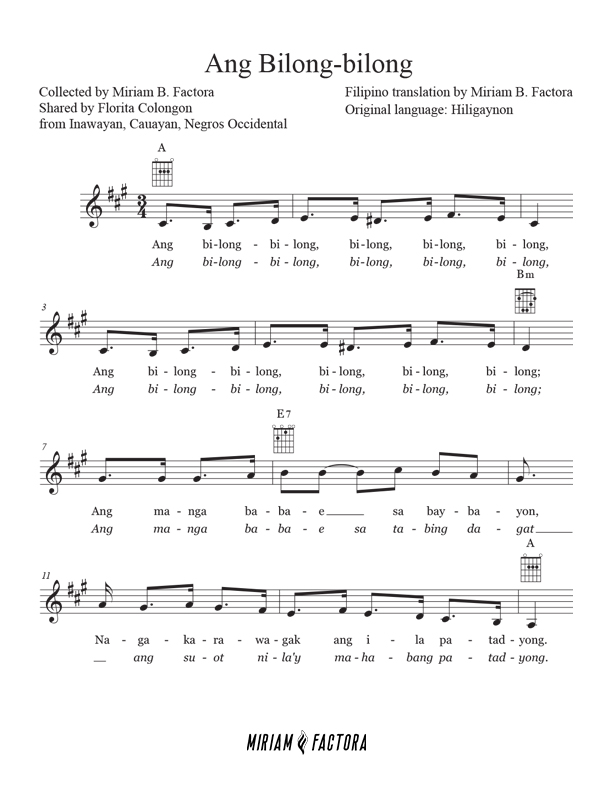
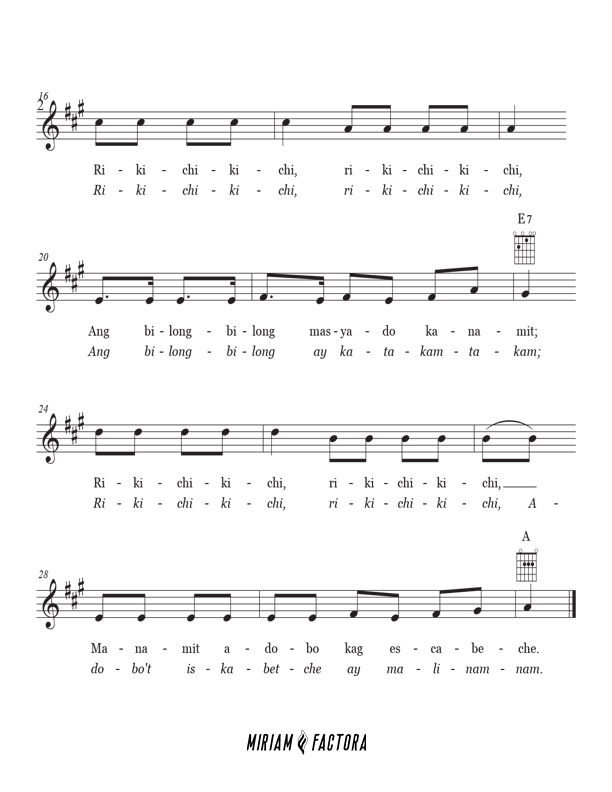
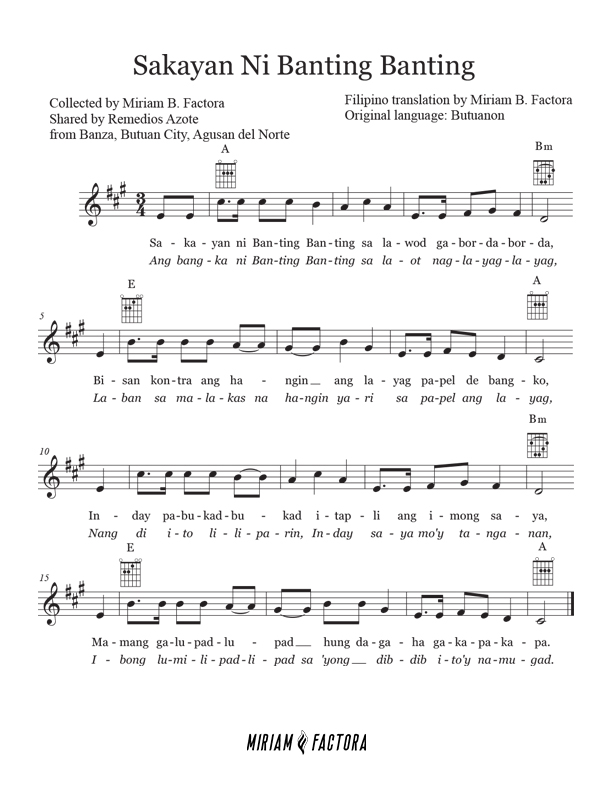
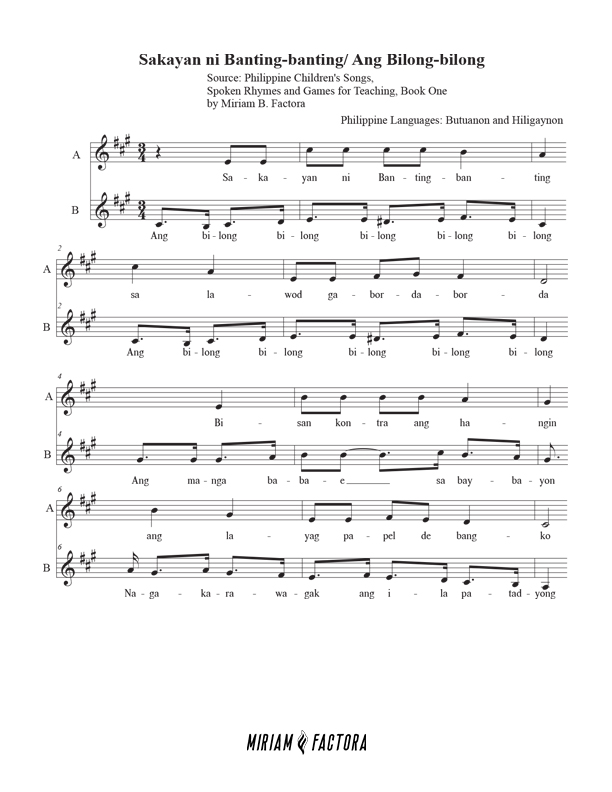
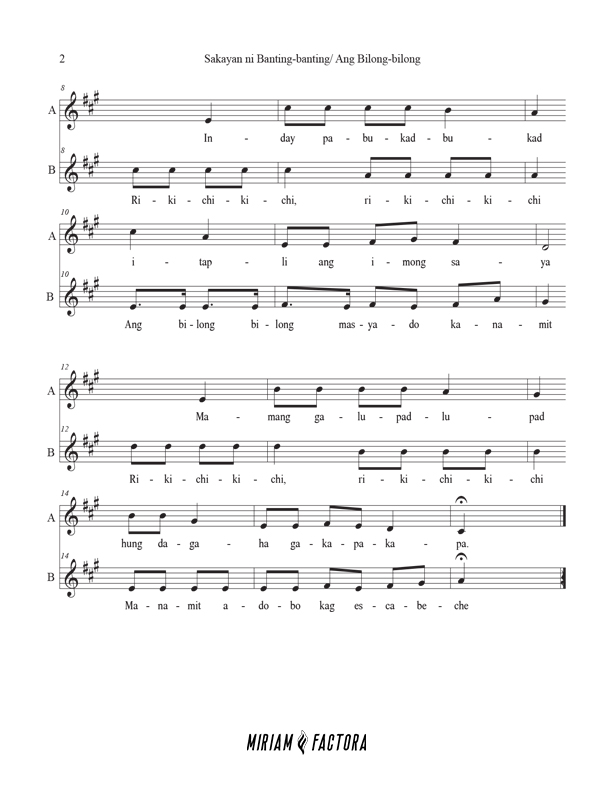
I collected these two folk songs in 1999. Ang Bilong-bilong, a traditional song in the Hiligaynon language, was shared by Mrs. Florita Colongon, a teacher who was born in Inawayan, Cauayan, Negros Occidental, and was then residing and teaching in Puerto Princesa, Palawan. Sakayan ni Banting Banting, a folk song in the Butuanon language, was contributed by Mrs. Remedios Azote, a homemaker from Banza, Butuan City, Agusan del Norte.
Given the Philippines’ rich diversity of ethnolinguistic groups, I felt it was important to translate and create a version in Filipino—the national language—while carefully preserving their textual, musical, and cultural integrity. This allows students to better understand the songs and provides opportunities to perform them in both the original language and Filipino, depending on their age and readiness.
The two folk songs both reflect the close relationship of Filipinos with the sea. In Butuan, the imagery of the boat and bird highlights the community’s seafaring heritage, resilience, and creativity. In Negros Occidental, the playful song about bilong-bilong fish and dishes like adobo and escabeche celebrates coastal life, food, and community joy. Both songs place women in central roles—whether as figures of admiration or as active participants by the shore—and show how music connects daily life, livelihood, and values such as resilience, creativity, and togetherness.
ANG BILONG-BILONG
SAKAYAN NI BANTING-BANTING
COMBINED
Ang Bilong-bilong
The *bilong-bilong, The women by the shore are wearing long skirts. Rikichikichi (2X), the bilong-bilong tastes so good, Rikichikichi (2X), *adobo and *escabeche taste so good.
*Bilong-bilong is a kind of fish *Adobo and escabeche are Filipino dishes
Sakayan ni Banting Banting
Banting Banting’s boat sails on the deep blue sea, Against the strong wind, its sail is paper money. Inday’s skirt is swaying as the breezes play, A bird is gently flying, seeking rest upon your bosom.
TARGET GRADE LEVELS: UPPER ELEMENTARY and SECONDARY
SUBJECT MATTER
Topic: Philippine Folk Songs in Triple Meter
Songs:
Ang Bilong-bilong
Language: Hiligaynon
Origin: Cauayan, Negros Occidental
Sakayan ni Banting Banting
Language: Butuanon
Origin: Butuan City, Agusan del Norte
Musical Concepts: 3/4 meter, anacrusis (upbeat), conducting, chord progression (A, E, E7, Bm), part singing
MATERIALS
Guitar
chord charts
staff notation
projector/board
cultural map of the Philippines
audio recording sung by Ma. Victoria V. Valdez
OBJECTIVES
COGNITIVE | Students will be able to:
Identify the 3/4 time signature of the two songs.
Explain the concept of anacrusis (upbeat) and locate it in both songs.
Recognize the guitar chords A major, E major, E7, and B minor.
Compare the two folk songs in terms of cultural origin (Butuanon vs. Hiligaynon).
PSYCHOMOTOR | Students will be able to:
Sing Sakayan ni Banting Banting and Ang Bilong-bilong accurately in pitch, rhythm, and text.
Conduct in 3/4 time while singing.
Demonstrate the upbeat (anacrusis) correctly in performance.
Play the chords A, E, E7, and Bm on the guitar as accompaniment.
Shift smoothly between chords while maintaining tempo.
Sing in parts by performing the two songs simultaneously as a partner-song.
Perform in ensemble, coordinating conducting, part singing, and guitar accompaniment.
AFFECTIVE | Students will be able to:
Show enjoyment and confidence while singing and playing.
Cooperate with peers in part-singing and ensemble performance.
CULTURAL | Students will be able to:
Connect the imagery in the songs Sakayan ni Banting Banting and Ang Bilong-bilong to real-life practices in Butuan (seafaring) and Negros Occidental (fishing and food culture).
Demonstrate appreciation for Philippine cultural diversity and similarities through folk songs from different ethnolinguistic groups.
Appreciate the role of folk songs in expressing the identity, traditions, and values of different Philippine communities.
PROCEDURE
MOTIVATION
Teacher plays a short clip of a waltz or familiar 3/4 rhythm.
Ask: “What makes this rhythm feel like a dance? Can you count it with me?”
Lead students in performing a body ostinato with one strong beat and two weak beats (example: clap for the strong beat, tap the shoulders for two weak beats)
While doing the body ostinato, count 1 on the strong beat and 2, 3 on the weak beats: ONE two three, ONE two three.
Review how musicians show one strong beat and two weak beats through conducting.
SUGGESTED ACTIVITIES (These activities may be carried out in different lesson segments.)
Introduce the two folk songs as 3-meter songs—their origins and languages:
Hiligaynon (Ang Bilong-bilong) from Cauayan, Negros Occidental
Butuanon (Sakayan ni Banting Banting) from Butuan City, Agusan del Norte
Show these locations on a Philippine map.
Review 3/4-time signature and practice conducting pattern while singing the songs.
Introduce anacrusis (upbeat) and locate it in the songs.
Teacher Prompt (Song 1): “When we conduct Sakayan ni Banting Banting, do we begin singing on the strong first beat?
Students’ Observation: Students observe and infer that the song actually begins on a weak beat, the third beat of the measure.
Teacher Conclusion: “That’s right. When a song does not begin on the strong first beat but instead enters on a weak beat, we call this an upbeat, or in music terms, anacrusis. It comes from the Greek word meaning, “upbeat.”
Teacher Prompt (Song 2): “Now let’s check Ang Bilong-bilong. Does it also begin right on the strong first beat?”
Students’ Observation: Students notice that this song also begins on a weak beat—the second beat; hence, an upbeat.
Teacher Conclusion: “Both songs share the same feature: they begin with an anacrusis.”
Teacher Explanation: The teacher then shows how the anacrusis appears in the songs’ notation, pointing out that the first measure looks incomplete because it begins on a weak beat. This “missing” part is balanced or completed at the very end of the song, where the final measure provides the remaining beats to make a full measure.
Perform the Filipino versions of the songs.
Present the guitar chords (A, E, E7, Bm) as accompaniment. Students play the chords.
Part Singing: Half the class sings Sakayan ni Banting Banting, the other half sings Ang Bilong-bilong simultaneously (partner-song style).
Ensemble: Combine conducting, part singing, and accompaniment for a full group performance.
Cultural Connection:
Points of Discussion:
“What does Sakayan ni Banting Banting tell us about Butuanon life?”
“What does Ang Bilong-bilong tell us about life in Negros Occidental?”
“What Filipino values are reflected in the songs?”
These songs show how people’s everyday lives and culture are closely connected to the sea.
Sakayan ni Banting Banting speaks about Butuan’s seafaring life, showing the people’s creativity and resilience. Ang Bilong-bilong shows the fishing life of Negros Occidental, highlighting food, fun, and community joy. Both songs teach us about important Filipino values:
Adapting to uncertainty: Life at sea and fishing are not always easy, so people learn patience and endurance.
Finding joy in struggle: The playful tone of the songs shows how Filipinos face challenges with humor, creativity, and cheer.
Strength in togetherness: The songs remind us that families, fisherfolk, and communities support one another through work and celebration.
Evaluation
Oral: Students identify the time signature and locate the upbeat in either song.
Performance:
Individually: Play chords (A, E, E7, Bm) correctly on the guitar.
In pairs: Sing while conducting, putting more awareness on the anacrusis.
In groups: Perform the two songs together with part singing and guitar.
Assignment / Enrichment
Research a folk song from your own community. Identify its meter and whether it begins with an upbeat. Prepare to share next class.
VALUES INTEGRATION
Emphasize cultural appreciation: Folk songs carry the traditions, identity, and values of different communities.
Highlight unity in diversity: Even though the songs come from different places and languages, they can blend beautifully when sung together. This reflects the Filipino value of unity in diversity—many voices, one harmony.
Encourage teamwork in part-singing and ensemble performance.